Bedding Guide
Down Comforter Construction: Baffle Boxes, Fill Power, and Shell Fabric
A down comforter’s warmth and feel come from a careful balance of materials and design. Fill power describes loft, fill weight tells you how much insulation is inside, baffle-box construction helps manage that fill, and shell fabric shapes the comforter’s breathability and touch. Knowing how these elements work together makes it easier to choose bedding for your room, climate, and preferred sleep temperature.
The quiet engineering beneath the cover
A down comforter can look simple: a soft, quilted rectangle laid across a bed. Yet inside that familiar form is a small system for managing air, heat, moisture, and movement. The fine clusters of down trap still air, the comforter’s internal construction keeps those clusters in place, and the shell contains the fill while allowing the finished piece to feel comfortable against the skin.
These details matter because warmth is not determined by a single number. A comforter with lofty down may feel light, but its total insulation also depends on how much down it contains, how evenly that fill is distributed, and whether the construction leaves cold gaps. A densely woven shell can help keep down inside, while its fiber, weave, and finish influence how the comforter feels and how readily air and water vapor move through it.
For shoppers comparing down comforters, the useful question is not simply, “Which one is warmest?” It is, “Which combination of loft, fill quantity, construction, and fabric suits the conditions in which I sleep?” A cool bedroom, a warm climate, a drafty home, and a naturally warm sleeper can all call for different choices.
What down does—and what it does not
Down is the soft, three-dimensional cluster found beneath the exterior feathers of birds. Its branching filaments create a light structure that can hold pockets of air. Because trapped air slows the movement of heat, down provides insulation without requiring a heavy, solid layer. This warmth-to-weight quality is one reason down is prized in bedding.
Down is not the same as a feather. Feathers have a central shaft, while down clusters are softer and lack that stiff quill. A comforter may contain down alone or a blend of down and feathers; the blend and its proportions affect loft, weight, feel, and price. Product descriptions should make the fill composition clear. If they do not, ask for clarification rather than assuming that a “down” label means a particular percentage or grade.
Down’s performance also depends on the condition and distribution of the fill. A well-made comforter can feel airy and evenly insulating, while poorly controlled fill may shift, compress, or gather into uneven patches. That is where construction becomes important: the internal design is responsible for giving the fill space to loft while limiting its migration.
Fill power: a measure of loft, not total warmth
Fill power describes the lofting capacity of down. In common testing, a measured quantity of down is allowed to expand under controlled conditions, and the volume it occupies is recorded. A higher fill-power number indicates that the down can loft more for a given amount of fill. More loft can mean more air is held within the clusters, creating the potential for efficient insulation.
It is tempting to read fill power as a direct warmth rating, but it does not work that way. Fill power describes the quality or loft potential of the down, not the total amount of down in the comforter. A comforter with high-fill-power down can still be relatively light and suited to milder conditions if it contains a modest fill weight. Another comforter with lower fill power may feel warmer overall if it contains substantially more fill.
Think of fill power as describing how much space the down can occupy, while fill weight tells you how much down has been put into the comforter. Both matter. A higher fill power may allow a manufacturer to achieve a desired level of loft with less material, potentially reducing weight. But a shopper seeking substantial insulation should not choose by fill power alone; the quantity of fill, comforter dimensions, construction, and intended warmth all deserve attention.
Comparisons are most useful when they involve products of similar size and intended use. A larger comforter naturally requires more fill to cover a broader area, and labels may use different warmth descriptions. Look for specific figures where available, then consider them alongside the maker’s guidance about season, room temperature, and care.
- Fill power: Indicates the loft potential of the down.
- Fill weight: Indicates the quantity of fill inside the comforter.
- Finished construction: Determines how the fill is held, distributed, and allowed to expand.
- Sleep conditions: Influence how much insulation will feel comfortable in everyday use.
Fill weight and the feel of warmth
Fill weight is the weight of the insulating material, not the weight of the entire comforter. It provides useful context for how much down is present, but it is not an independent guarantee of warmth. Two comforters with the same fill weight may differ in fill power, shell fabric, size, construction, and distribution—all of which can change the finished experience.
In general, more fill can provide greater insulation, particularly when the design allows it to loft. But a heavier comforter is not automatically a better one. Some sleepers prefer a light, airy cover; others enjoy a more substantial layer. The surrounding room matters too. Heating systems, drafts, bedding layers, and seasonal temperature swings can change how a comforter performs from one night to the next.
If a product listing provides both fill power and fill weight, read the figures together. If it gives only a warmth label such as “light,” “all-season,” or “extra warm,” treat that as a starting point rather than a universal standard. Labels may be assigned differently among manufacturers. When precise details are absent, ask about the intended temperature range, fill composition, and whether the design is meant for year-round use or a particular season.
Baffle-box construction: room for down to rise
In a baffle-box comforter, narrow fabric walls connect the upper and lower shell layers to form three-dimensional compartments. These internal walls are called baffles. Unlike a simple stitched-through design, where the top and bottom fabrics are sewn directly together along lines, baffles create space between the shell layers. That depth gives the down room to expand into loft.
The compartments help limit the distance fill can travel. If down were free to move throughout the comforter, it could collect at the edges or in isolated areas, leaving other sections thin. Baffles create boundaries that support more even distribution, although no construction can compensate for poor workmanship or inappropriate fill quantity. The comforter still needs adequate filling in each compartment and strong, consistent seams.
Baffle-box designs can also reduce the cold lines associated with some sewn-through patterns. In a sewn-through comforter, the stitching joins the shell layers, compressing the fill at each seam. These lines can form narrow areas with less insulation. Baffles avoid that direct compression along the compartment walls by keeping a space between the top and bottom fabrics. The result is often a more continuous field of loft, though the finished performance depends on design and execution.
Not every comforter uses baffle boxes, and the term should not be treated as a guarantee of premium quality. Stitching quality, compartment size, edge construction, fill distribution, and shell fabric all contribute. Some designs use other internal quilting or channel arrangements to control movement. A sound comparison looks at the complete construction rather than a single feature name.
When evaluating baffle-box construction, consider whether the compartments appear suited to the comforter’s size and intended use. Large chambers may allow generous loft but can make the distribution of fill more noticeable if the comforter is not handled and maintained as recommended. Smaller compartments can help keep fill controlled, though their structure may affect how freely the down expands. Manufacturers may not publish compartment dimensions, but questions about construction are reasonable when choosing a long-term bedding investment.
Shell fabric: the comforter’s weather boundary
The shell is the outer fabric that contains the down. It must be closely woven enough to limit feather and down leakage while remaining comfortable in contact with other bedding. Its texture, weight, and finish influence the hand—the way the fabric feels—as well as how the comforter moves, breathes, and responds to moisture.
Cotton is a common shell fiber because it can be soft and breathable, but “cotton” alone does not describe the full experience. Weave and thread construction matter. A tightly woven shell may help contain fine fill, while a lighter fabric can feel more supple. Some shells use blends or other fibers, and finishes may alter their smoothness or crispness. If tactile preference is important, look for specific fabric information rather than relying only on broad claims such as “soft” or “luxurious.”
Breathability is also more complex than a fabric label. It depends on the fiber, weave, fabric weight, finish, and the complete comforter design. A breathable shell can help water vapor move away from the sleep surface, but the fill and room conditions also affect comfort. For someone who tends to sleep warm, a high-loft comforter with a dense, heavy shell may feel different from a lighter construction with a more airy cover—even if the fill specifications appear similar.
A tightly woven shell is often used to help contain down, but tightness should be balanced with comfort and airflow. Very crisp fabric may rustle as the comforter moves; a softer shell may drape more easily. Neither quality is inherently better. The right choice depends on whether you value a smooth, quiet feel, a light drape, a crisp finish, or another tactile quality.
A duvet cover can protect the comforter shell from direct contact with skin, body oils, and everyday wear. It also makes it easier to change the bed’s color or texture without replacing the insulating layer. Even so, the comforter’s own shell remains important: it holds the fill, contributes to the finished weight, and may affect how the comforter breathes beneath a cover.
Choosing for climate and sleep preference
Start with the room, not the marketing category. Consider typical overnight temperatures, whether the room is heated or cooled, how much bedding you already use, and whether the bed is exposed to drafts. A comforter intended for a cool bedroom may feel excessive in a consistently warm space. A lighter option may suit a heated home or a sleeper who prefers minimal insulation, while colder rooms may call for more fill or a warmer overall construction.
Personal sleep temperature matters just as much. One person may wake warm beneath a comforter that feels comfortable to another. If you share a bed, you may need to balance different preferences with breathable sleepwear, separate blankets, or an adaptable bedding arrangement. The goal is not maximum warmth; it is a stable, comfortable temperature through the night.
For broad seasonal changes, consider whether the comforter will be used alone, layered, or replaced at certain times of year. A duvet cover and light blanket can provide flexibility, but extra layers can also trap more heat. A well-matched comforter should work with the rest of the bed rather than being judged in isolation.
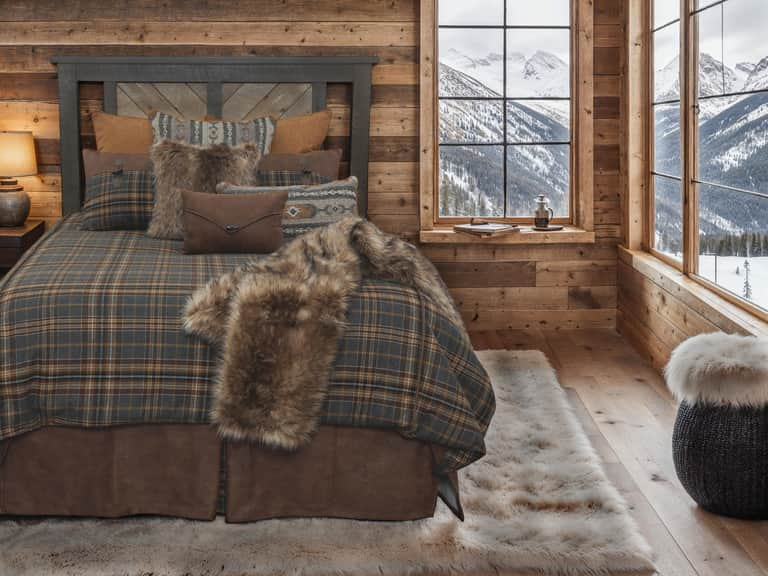
The Kinsale Oxford Duvet is a coordinated bedding option described with a wool plaid fabric, Nougat fabric accents, and faux-leather details. Its materials and lodge-inspired styling are specified, but the available product information does not identify it as down-filled or provide fill-power and fill-weight figures. For a shopper comparing down comforter construction, those technical details should be confirmed rather than inferred from appearance or the word “duvet.”
Care, maintenance, and longevity
Down can retain loft over time when it is cared for according to the manufacturer’s instructions. A duvet cover helps reduce direct soiling, while regular airing may help refresh bedding between washes. Cleaning methods differ among products, however, so do not assume every comforter can be machine washed or dried at home. Check the care label before cleaning; incorrect washing or incomplete drying can damage the fill, shell, or construction.
When a comforter is washable, use the specified process and ensure it dries completely. Damp clusters can clump, reducing loft and creating an unpleasant odor. Avoid storing the comforter compressed for long periods if the care guidance recommends room to breathe. A breathable storage bag and a dry, clean location can help protect it between seasons.
It is normal for a small amount of down to escape occasionally, especially near seams or after extended use. Persistent leakage, thinning areas, or uneven fill may indicate a problem with the shell or construction. A protective cover reduces wear but cannot repair a damaged seam. Inspect the comforter periodically and follow any warranty or repair guidance supplied by the maker.
A practical comparison checklist
Before choosing among down comforters, use the product description to answer a few concrete questions. If essential figures are missing, treat the uncertainty as part of the comparison. Clear specifications make it easier to understand what is inside the comforter and whether its design suits your sleep environment.
- What is the fill? Confirm whether it is down, a down-and-feather blend, or another material, and check the stated composition.
- What is the fill power? Use it as an indicator of loft potential, not as a standalone warmth rating.
- What is the fill weight? Compare it with the comforter’s size and intended warmth category.
- How is the fill contained? Look for baffle-box, sewn-through, channel, or other construction details.
- What is the shell made from? Consider fiber, weave, feel, and any information about containment or breathability.
- How should it be cared for? Confirm cleaning, drying, and storage requirements before purchase.
- How will it be used? Account for bedroom temperature, personal sleep habits, duvet covers, and other layers.
Reading the details as a whole
Fill power, fill weight, baffle-box construction, and shell fabric each describe a different part of a down comforter’s performance. Fill power points to the down’s ability to loft; fill weight indicates how much is used. Baffles provide structure that can help preserve space and distribute fill, while shell fabric contains the down and shapes the comforter’s feel and airflow.
None of these features works alone. High fill power does not guarantee the warmest comforter, and baffle boxes do not automatically mean better workmanship. A breathable shell cannot offset a comforter that is too warm for the room, just as an ample fill weight may not deliver even insulation if fill shifts or compresses. The most useful choice is the one whose complete design aligns with the way and place you sleep.
Read specifications carefully, compare products of similar size and intended use, and prioritize clear information over vague claims. With that approach, the numbers become more than labels: they reveal how a comforter is built and what kind of nightly environment it is designed to create.